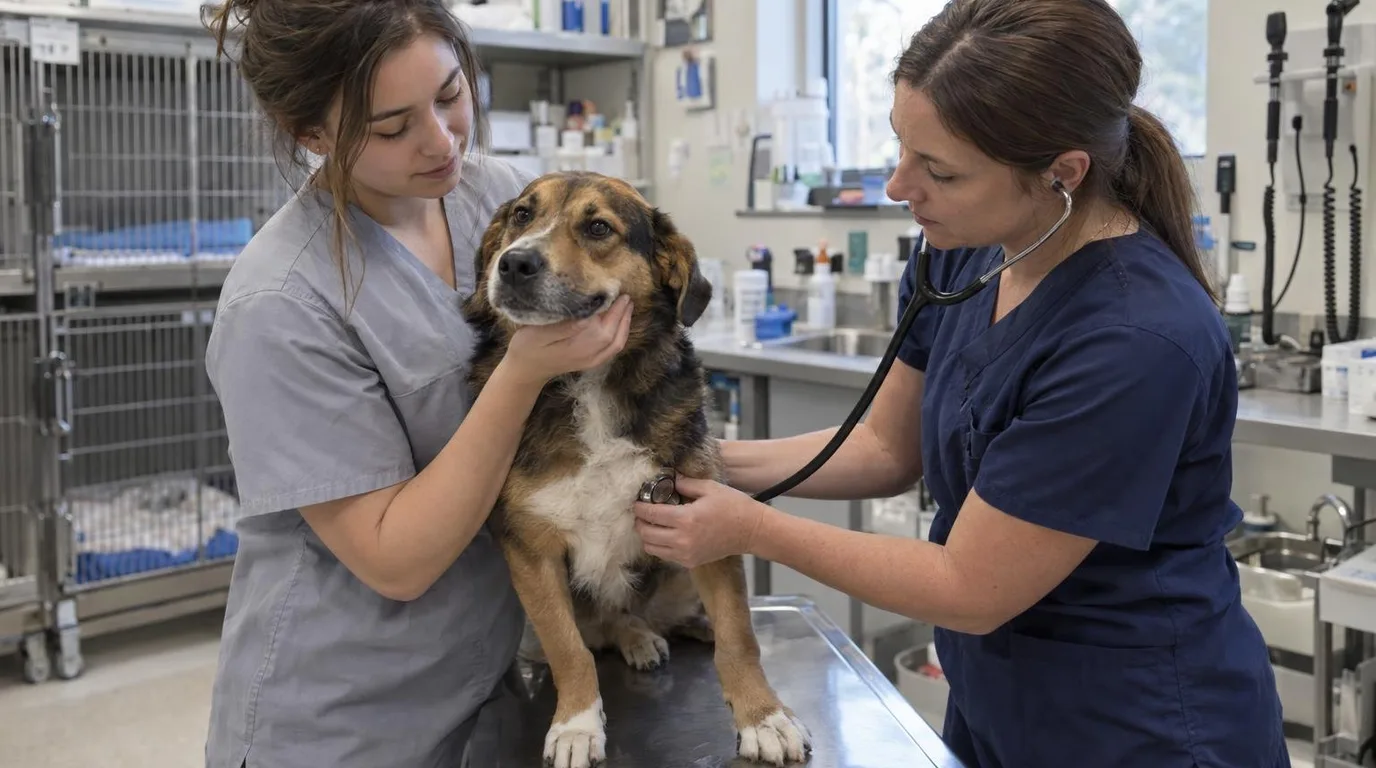
To become a veterinary assistant, you usually need a high school diploma or GED and a practice willing to train you. In most states there's no exam or license for the job. Most assistants learn on the job, and a certificate program is optional, though it can make your first application stronger.
This guide is for people who want their first job in a veterinary hospital: high school students, career changers, and kennel or shelter workers who want to move into clinical work. It covers what employers ask for, what each training route costs, what assistants may legally do in two very different states, and how the job leads to a vet tech credential if you want one later.
Do you need a certificate to be a vet assistant?
No, not in most places. The Bureau of Labor Statistics says most veterinary assistants have a high school diploma or equivalent and receive short-term on-the-job training, and that certification is not mandatory.
Two things can change that answer for you.
Your state may add a permit for certain tasks. California is the clearest example. A veterinary assistant there can't obtain or administer controlled substances without a Veterinary Assistant Controlled Substances Permit (VACSP) from the Veterinary Medical Board. Permit holders must be at least 18 and pass a Live Scan fingerprint background check, and the board won't issue a permit to anyone with a state or federal felony controlled substance conviction. You can work as an assistant in California without the permit. You just can't handle controlled drugs.
Your employer may want a certificate. Some hospitals, especially in competitive markets, prefer applicants who finished a training program or hold a voluntary designation like NAVTA's Approved Veterinary Assistant (AVA). That's a hiring preference, not a legal requirement.
One common claim online is that Texas requires assistants to hold a state certification. It doesn't. Texas law recognizes a "certified veterinary assistant" as someone certified by the Texas Veterinary Medical Association, and it separately defines a "veterinary assistant" as an employee of a licensed veterinarian who performs animal care tasks without that certification (Texas Occupations Code, Chapter 801). Both can work in Texas.
Vet assistant job requirements employers actually list
Most listings ask for some version of the following:
- High school diploma or GED, and sometimes a minimum age of 18
- Ability to lift, move, and restrain animals, often with a coworker's help
- Comfort with blood, needles, euthanasia, and fractious or frightened animals
- Willingness to work weekends, evenings, or holidays
- Basic computer skills for practice management software
- Previous animal experience, which is "preferred" far more often than "required"
The physical side is real. BLS notes that veterinary assistants and laboratory animal caretakers have one of the highest rates of injuries and illnesses of all occupations, mostly bites, scratches, and injuries from holding or restraining animals. Good restraint technique protects you, the patient, and the person holding the needle.
If you're still deciding between this job and a credentialed tech role, our vet tech vs. vet assistant comparison lays out the differences in training, duties, and pay.
Four ways to become a vet assistant
1. Get hired and trained on the job
This is the most common route and it costs nothing. Many people start as a kennel attendant, receptionist, or "assistant trainee" and learn restraint, cage care, surgical pack prep, and lab basics from the techs they work with. The quality of that training depends entirely on the practice, so ask in the interview who will train you and for how long.
2. Complete a NAVTA-approved veterinary assistant program
NAVTA, the national association for vet techs, approves veterinary assistant training programs. There are more than 65 of them in the U.S. and Canada, offered by community colleges, technical schools, high school career centers, and online providers (NAVTA). Graduates are eligible to take the Approved Veterinary Assistant exam, which costs $100 and is delivered through VetMedTeam on NAVTA's behalf. A veterinarian, credentialed tech, program instructor, or testing center proctors it (NAVTA).
Passing earns you the AVA designation. You renew it every two years with at least 10 hours of veterinary continuing education. It's a professional designation, not a state license, and it doesn't let you do anything your state reserves for credentialed techs.
NAVTA keeps the current list of approved programs. Check that list yourself before you enroll. A school using words like "NAVTA-aligned" isn't the same as being on it.
3. Earn a state association certification
Some state veterinary medical associations run their own assistant certification. The longest-running is the TVMA Certified Veterinary Assistant program in Texas, which is designed to be completed while you work. Level I requires 500 hours of work experience supervised by a veterinarian or licensed tech, a signed skills checklist, and a passing score of 70% on the exam. There are three levels, and you need six months at one level before you can test for the next.
The program is open to applicants outside Texas, and Patterson Veterinary Academy sells CVA prep courses tied to programs in more than 10 states. If your state VMA has its own version, local employers may know it better than the national AVA.
4. Start in high school
Many high schools run veterinary science or animal care courses through career and technical education. Some of these lead to a recognized credential. TVMA, for example, lets students in school-based programs test for CVA Level I at age 16 after at least 200 hours in the program (TVMA). Ask your school counselor what your district offers, and whether it includes clinic hours.
What a good program covers, and what it costs
A solid program teaches the work you'll do on day one:
- Restraint and safe handling of dogs and cats
- Medical terminology and basic anatomy
- Exam room and surgical prep, instrument care, and sterilization
- Lab sample collection and handling, and basic radiology safety
- Pharmacy math and filling prescriptions as directed
- Client communication and medical records
- An in-person externship at a real practice
The externship matters most. You can't learn to hold a frightened cat for a blood draw from a video. Ocean County College's NAVTA-approved program, for example, combines 100 hours of in-class instruction, 50 hours of online work, and a 100-hour clinical externship, and covers lab, radiology, pharmacy, surgery and recovery, and animal CPR (Ocean County College).
Here is what the main routes cost, based on the providers' own pages:
| Route | What you pay | Time |
|---|---|---|
| On-the-job training | $0, and you're paid while you learn | Weeks to months |
| TVMA CVA Level I | $145 exam fee; optional training manual $169.95 for members or $199.95 for nonmembers; $30 annual renewal | 500 supervised work hours |
| Penn Foster online program (NAVTA-approved) | $1,089 list price, with pay-in-full discounts that change often | About 12 to 16 months, plus an 8 to 16 week in-person externship |
| Ocean County College, New Jersey (NAVTA-approved) | $3,750 | About 4 months |
| AVA exam after any NAVTA program | $100 | One exam |
Sources: TVMA, Penn Foster tuition and curriculum, Ocean County College, and NAVTA.
Budget for extras too: scrubs, closed-toe shoes, background checks, and vaccinations. Ocean County College, for one, requires a clear criminal background check and a tetanus shot.
So, how much does it cost to become a vet assistant? Anywhere from nothing to a few thousand dollars. If a local practice will hire and train you, paying for a program first rarely makes financial sense. A program earns its cost when local employers keep asking for formal training, or when you want structured externship hours you can't get any other way.
What a vet assistant may and may not do
Your state's veterinary practice act sets the limits, not your job title or your certificate. Two large states show how far apart the rules can be.
California. Assistants may perform "auxiliary animal health care tasks" under the direct or indirect supervision of a veterinarian, or the direct supervision of a registered veterinary technician. They may not do anything the regulations reserve for RVTs, which includes inducing anesthesia, extracting teeth, suturing, and creating the relief hole for an IV catheter (16 CCR sections 2036 and 2036.5). The board also says unlicensed staff may operate radiographic equipment only after specific training and only under direct supervision (California VMB).
Texas. The supervising veterinarian decides what to delegate and how closely to supervise it. Texas law lets a certified veterinary assistant or veterinary assistant suture existing surgical skin incisions and lacerations and induce anesthesia, but only under immediate supervision, meaning the supervisor is within sight and hearing of both the patient and the assistant. The statute names a veterinarian as the supervisor and also lets a licensed veterinary technician immediately supervise these tasks (Texas Occupations Code sections 801.002 and 801.364).
So inducing anesthesia is off limits for a California assistant and allowed in Texas, with a veterinarian or licensed tech right there. In both states, nobody but the veterinarian may diagnose, give a prognosis, prescribe, or perform surgery.
If you move or get a job offer in another state, find that state's veterinary board through the AAVSB license lookup page and read the rules on assistants. If a practice asks you to do something you think is outside your state's rules, ask the supervising veterinarian to show you where the rule allows it.
How much do vet assistants make?
The median annual wage for veterinary assistants and laboratory animal caretakers was $38,150 in May 2025, or $18.34 an hour. The lowest 10% earned less than $30,120 and the highest 10% earned more than $49,150 (BLS pay data).
BLS groups assistants with laboratory animal caretakers, so setting matters. The median was $37,930 in veterinary services, which employs 86% of the occupation, compared with $49,230 in scientific research and development and $47,860 in schools and universities. Research facilities pay more, but they're a small share of the jobs.
BLS projects employment to grow 9% from 2025 to 2035, much faster than the average for all occupations, with about 23,200 openings a year (BLS job outlook). Many of those openings come from people leaving the job or moving into other roles, including vet tech.
For pay across every veterinary role, see our veterinary salary guide.
How to get hired with no experience
BLS says experience working with or being around animals may help job seekers. Here are practical ways to get it.
- Take a kennel or animal care job first. Kennel attendant and boarding roles at veterinary hospitals are often the easiest way in, and many hospitals promote from that pool.
- Volunteer at a shelter or rescue. You'll learn to read animal body language and handle animals that are scared, and you'll have a reference who has watched you work.
- Ask a local practice about shadowing. A few hours watching appointments tells you whether you can handle the job, and it shows the practice you're serious.
- Earn a Fear Free certification. Fear Free's online program teaches low-stress handling and is open to all veterinary practice staff. The individual veterinary professional membership is $299 for the first year and $149 a year to renew, and students in veterinary assistant programs can get a one-year academic membership for $49 (Fear Free pricing, student pricing).
- Apply to general practices and high-volume hospitals. They hire entry-level assistants most often and usually have techs on staff who can train you.
- Be ready for a working interview. Many practices ask candidates to spend a shift on the floor. Ask whether it's paid. Our working interview guide explains what to expect.
Common vet assistant interview questions
You don't need clinical answers for an assistant interview. Practices want to know whether you'll be safe, reliable, and kind under pressure. Expect questions like these:
- Why do you want to work in a veterinary hospital? "I love animals" is a start. Add something specific, like a shelter shift you enjoyed or a vet visit that made you curious about the work.
- How would you handle a dog that's trying to bite? Say you'd stop, tell the tech or doctor, and wait for help or a muzzle rather than forcing it. Safety first is the right answer.
- How do you feel about euthanasia? Be honest. Practices want to know you can stay steady and respectful with grieving clients.
- Tell me about a time you made a mistake at work. Pick a real example where you told someone quickly and fixed it.
- What's your availability for weekends and holidays? Answer clearly. Scheduling is often what decides an entry-level hire.
- What would you do if a client was upset about a bill? Listen, stay calm, and bring in the person who can answer. Assistants usually don't negotiate pricing.
Ask your own questions too: who will train you, how long training lasts, what assistants do here compared with techs, and whether the practice helps pay for training or CE. For more clinical questions you may get later in your career, see our vet tech interview questions.
From vet assistant to credentialed vet tech
Many techs start as assistants. To earn a CVT, LVT, RVT, or LVMT credential, most states require you to graduate from a program accredited by the AVMA's Committee on Veterinary Technician Education and Activities, then pass the Veterinary Technician National Exam. The AVMA's list of accredited programs includes distance-learning programs, which let you keep working as an assistant while you study and complete clinical requirements at your practice.
The move pays. The median vet tech earned $47,380 in May 2025, about $9,200 more than the median assistant (BLS). The credential also lets you take on anesthesia, dental, and nursing work your state reserves for techs.
A few states have had alternate routes that let experienced assistants sit for the VTNE without a degree. These are shrinking. Check with your state board before you plan around one. Our guide on how to become a vet tech walks through the steps, timeline, and costs, and what vet techs do covers the job itself.
Next steps
Browse vet assistant jobs on VeterinaryHire and filter by location and practice type. Many listings say whether the practice trains new assistants. Before you apply, use our resume and cover letter templates, which include a version for veterinary assistants, and check the veterinary salary guide so you know what pay to expect. When you're ready for the next step, read how to become a vet tech.
Sources
- U.S. Bureau of Labor Statistics, Occupational Outlook Handbook: Veterinary Assistants and Laboratory Animal Caretakers, May 2025 pay data, industry wages, training, injury rates, and projections for 2025 to 2035.
- U.S. Bureau of Labor Statistics, Occupational Outlook Handbook: Veterinary Technologists and Technicians, May 2025 pay data.
- NAVTA, Veterinary Assistants Program (AVA exam fee and renewal), AVA program guidelines, and approved AVA programs.
- Texas Veterinary Medical Association, Certified Veterinary Assistant program, and Patterson Veterinary Academy, CVA program.
- Texas Legislature, Occupations Code Chapter 801, Veterinary Licensing Act, sections 801.002, 801.363, and 801.364.
- California Veterinary Medical Board, RVT job task regulations, 16 CCR sections 2036 and 2036.5, Who's who in the vet office, and VACSP FAQs.
- Ocean County College, Veterinary Assistant program, and Penn Foster, Veterinary Assistant tuition and curriculum. Program prices are listed as examples, not recommendations.
- Fear Free, membership pricing and students and faculty pricing.
- American Veterinary Medical Association, Veterinary technology programs accredited by the AVMA CVTEA, and American Association of Veterinary State Boards, Veterinary Technician National Exam and Look up a license.
The interview questions and job-search advice are practical guidance, not survey findings. Program prices change often, and scope of practice differs by state, so confirm costs with the school and rules with your state veterinary board. Sources checked October 16, 2026.