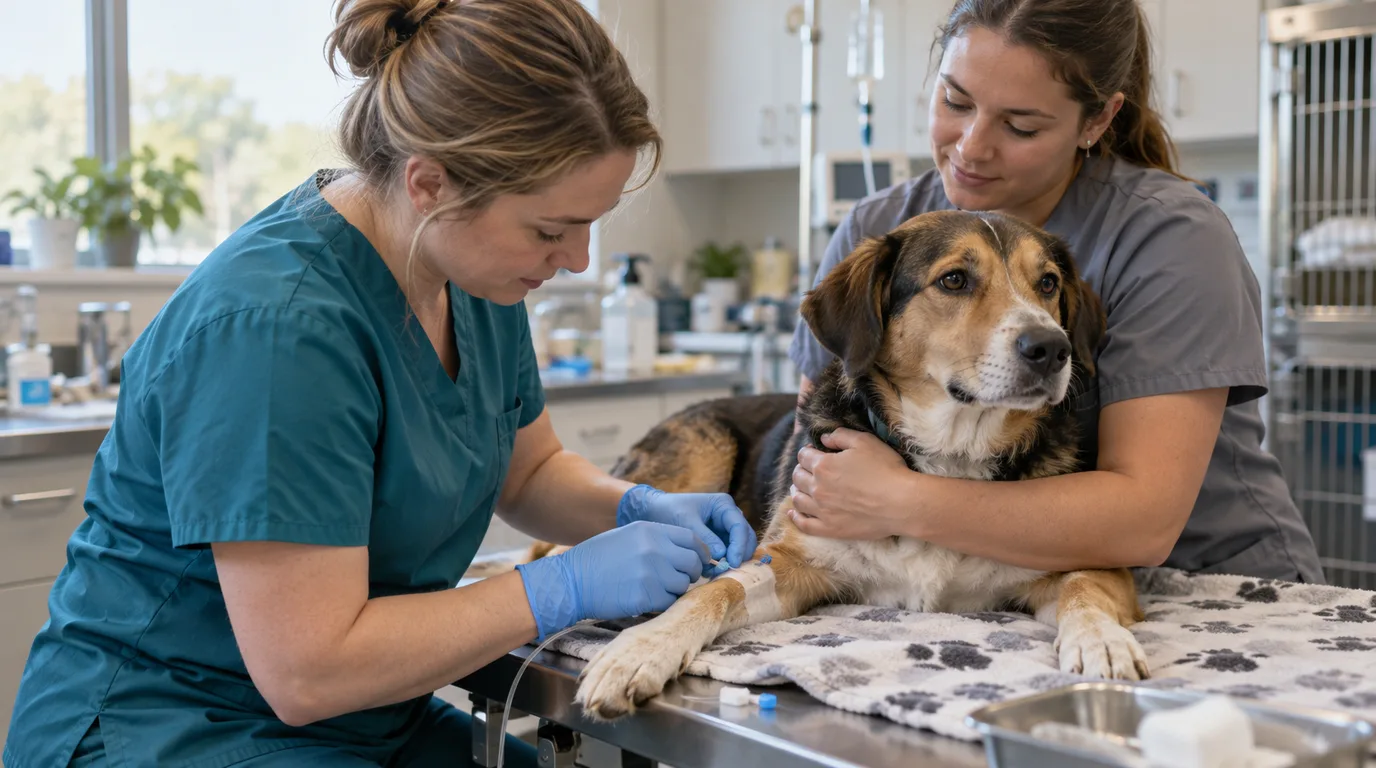
A veterinary technician is a credentialed professional who has graduated from an accredited program and passed a national exam. A veterinary assistant usually learns on the job and isn't credentialed by the state. Techs handle skilled nursing work like anesthesia, catheters, and radiographs, while assistants focus on restraint, kennel care, and cleaning. In May 2025, the median tech earned $47,380 and the median assistant $38,150.
CVT, LVT, RVT, and LVMT aren't different jobs. They're the titles different states use for a credentialed vet tech. "Veterinary nurse" is a newer title for the same credentialed role, recognized in law in only a few states.
Vet tech vs. vet assistant at a glance
| Veterinary technician | Veterinary assistant | |
|---|---|---|
| Training | Accredited program, usually a two-year associate degree | Usually on-the-job; optional certificate programs |
| National exam | VTNE, required in most states | None required; optional AVA exam |
| Credential | Issued by the state (CVT, LVT, RVT, LVMT) | None from the state in most places |
| Typical duties | Anesthesia, catheters, dental radiographs, lab work, client education | Restraint, kennel care, cleaning, stocking, sterilizing instruments |
| Median pay, May 2025 | $47,380 ($22.78/hr) | $38,150 ($18.34/hr) |
Pay figures are BLS national medians for veterinary technologists and technicians and for veterinary assistants and laboratory animal caretakers. BLS groups assistants with lab animal caretakers, so that median includes some research jobs.
What each role actually does
A credentialed veterinary technician is the nurse of the animal hospital. Techs induce and monitor anesthesia, place IV catheters, take radiographs, run blood work, and teach clients how to give medications at home. Our guide to what a vet tech does walks through a typical day.
A veterinary assistant supports the doctors and techs. Assistants restrain patients, feed and walk hospitalized animals, clean kennels and exam rooms, stock supplies, and sterilize surgical packs. Most have a high school diploma and get short-term on-the-job training, according to BLS.
In real clinics, the line blurs. In NAVTA's 2024 member survey, 48% of credentialed techs said there was little difference between their duties and those of uncredentialed staff where they worked (NAVTA, 2025). Some of that is assistants doing tech work, which may cross legal lines. Some is techs doing assistant work, which wastes their training.
What each person may legally do is set by the state's veterinary practice act, not by the job title. Diagnosing, prescribing, and surgery stay with the veterinarian everywhere. Tasks like inducing anesthesia or extracting teeth may be limited to credentialed techs, or not allowed for either role, depending on the state.
CVT vs. LVT vs. RVT vs. LVMT
They're the same credential with different names:
- CVT: certified veterinary technician
- LVT: licensed veterinary technician
- RVT: registered veterinary technician
- LVMT: licensed veterinary medical technician, used in Tennessee
Your state picks the title. The path is similar everywhere: graduate from a program accredited by the AVMA's Committee on Veterinary Technician Education and Activities (AVMA program list), pass the Veterinary Technician National Exam, then meet any extra state requirements. If you move, you apply for the new state's credential. Your VTNE score transfers through the AAVSB.
Veterinary technologist is a related term. BLS uses it for people with a four-year bachelor's degree in veterinary technology, who often work in research or advanced clinical roles. In most clinics, technologists and technicians do the same job.
Is a veterinary nurse the same as a vet tech?
In the U.S., a "veterinary nurse" is meant to be a credentialed vet tech under a different name. NAVTA, the national association for techs, supports the title for credentialed techs only and asks employers not to use it for uncredentialed staff (NAVTA).
The law hasn't caught up everywhere. A few states have written "veterinary nurse" into law as equivalent to a veterinary technician, including Maryland and New Hampshire. Earlier bills in Tennessee and Ohio drew opposition from human nursing groups (Canadian Veterinary Journal, 2019). Several university hospitals, including Penn, Kansas State, and Michigan State, already use the title for their credentialed staff.
Title protection for "veterinary technician" is growing too. NAVTA's 2022 review counted 11 jurisdictions with general title protection, and Colorado, Hawaii, Minnesota, Montana, New Hampshire, North Carolina, and South Carolina have added protection since. In those states, calling an uncredentialed assistant a "vet tech" can break the law.
Other titles you'll see
Approved Veterinary Assistant (AVA). A voluntary designation from NAVTA. You complete a NAVTA-approved assistant program, of which there are more than 65 in the U.S. and Canada, then pass an exam administered through VetMedTeam for a $100 fee (NAVTA). It isn't a state credential and doesn't let you do tech-level tasks, but it shows an employer you've had structured training.
Veterinary Technician Specialist (VTS). An advanced credential for experienced techs in areas like anesthesia, emergency and critical care, dentistry, and internal medicine. There are 16 NAVTA-recognized academies covering 27 specialties (NAVTA).
Veterinary Professional Associate (VPA). A new mid-level role created by Colorado voters through Proposition 129 in 2024, similar in concept to a physician assistant. Colorado's law took effect January 1, 2026, and the state board is writing the rules on scope and supervision (Colorado DPO). The role requires a master's-level program, and Colorado State University runs the first one. The AVMA, NAVTA, and many state veterinary associations oppose it, citing patient safety (AVMA, March 2026). For now, it exists only in Colorado.
Which path is right for you?
Start as an assistant if you want to work with animals now, aren't sure veterinary medicine is for you long term, or can't commit to two years of school yet. Assisting is how many techs and vets find out whether they like the work.
Become a credentialed tech if you want more clinical responsibility, higher pay, and a title that moves with you between practices and states. The median tech earned about $9,200 more a year than the median assistant in May 2025, and the credential opens specialty paths like the VTS that assistants can't take.
You don't have to choose once. Many AVMA-accredited programs are offered through distance learning, so you can study while working as an assistant. Some states used to offer alternate routes for experienced assistants to sit for the VTNE without a degree, but these are shrinking. Check with your state board before you plan around one.
For practices: which role are you hiring?
Write the job for the work you need done. If you need someone to run anesthesia and take dental radiographs, you need a credentialed tech and should post a tech's pay. If you need restraint, cleaning, and kennel care, hire an assistant and title the job that way. Our vet tech job description template covers the wording, including title rules.
Mixing the two causes problems either way. Credentialed techs leave jobs where they do assistant work, and assistants doing tech work may be practicing outside what your state allows.
Next steps
Browse vet tech and vet assistant jobs on VeterinaryHire, and filter by role and location. For pay by state, see our veterinary salary guide. Heading to an interview? Read our vet tech interview questions guide.
Sources
- U.S. Bureau of Labor Statistics, Occupational Outlook Handbook: Veterinary Technologists and Technicians and Veterinary Assistants and Laboratory Animal Caretakers, May 2025 pay data and training requirements.
- American Veterinary Medical Association, Veterinary technology programs accredited by the AVMA CVTEA and Veterinary professional associate: AVMA clarifies the profession's concerns (March 16, 2026).
- American Association of Veterinary State Boards, Veterinary Technician National Exam.
- NAVTA, Veterinary nurse and technician title use resources (title protection figures current as of March 2025), Veterinary Assistants Program, veterinary technician specialties, and 2024 Demographic Survey results.
- Colorado Division of Professions and Occupations, Veterinary Professional Associate information, and Colorado State University, About the veterinary professional associate.
- Canadian Veterinary Journal, Registered Veterinary Nurse? (2019), on early state veterinary nurse bills.
Titles, scope of practice, and credentialing rules differ by state and change often. Confirm them with your state veterinary board. Sources checked September 28, 2026.