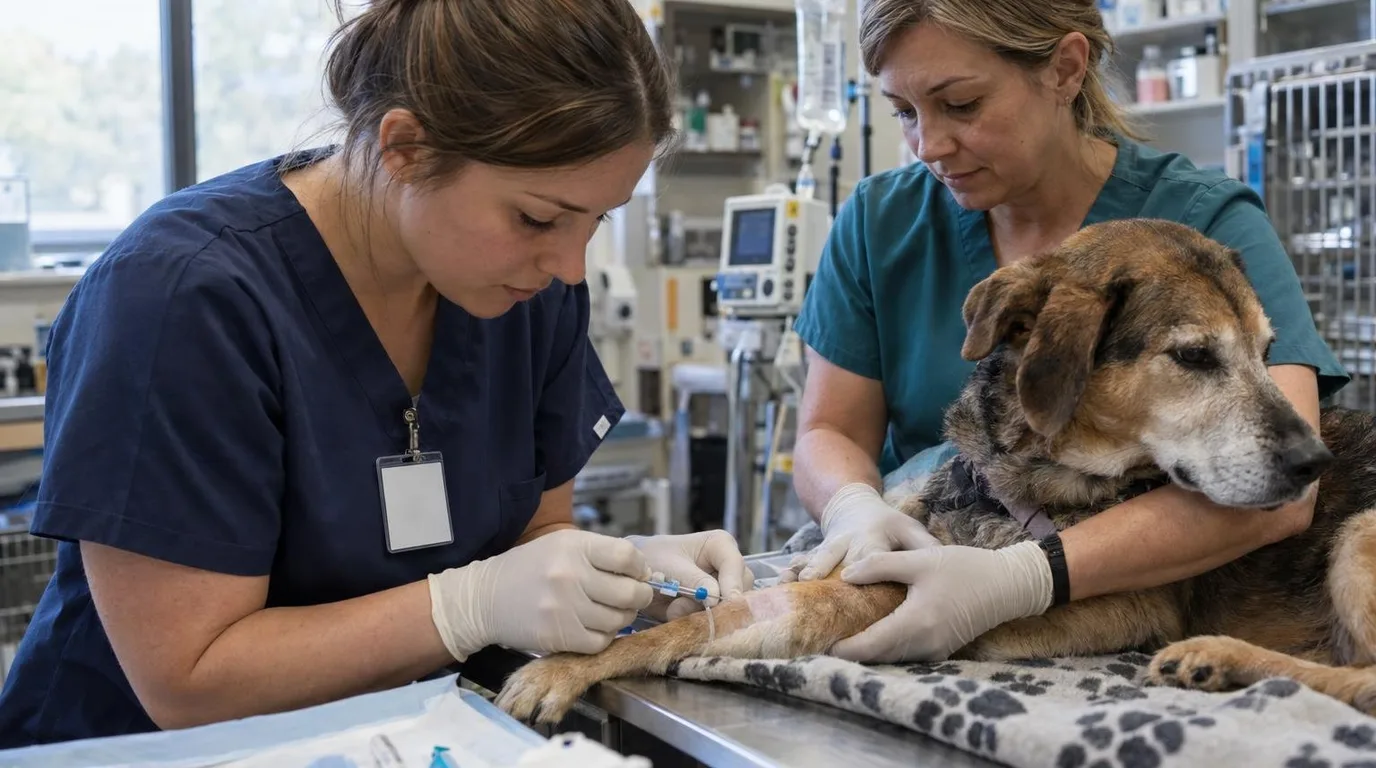
To become a vet tech, you graduate from a veterinary technology program accredited by the AVMA, pass the Veterinary Technician National Exam (VTNE), and apply for your state's credential. Full time, that usually takes about two years with an associate degree. Part-time distance programs often take three to four.
This guide is for people deciding whether to start: high school graduates, career changers, and veterinary assistants who already work in a clinic. Most of the top search results for this question are written by schools selling a program. We used program pages, state boards, and the exam owner to show what each route takes, so you can compare them yourself.
The short version
- Finish high school or a GED, plus any college biology, chemistry, or math your target program requires.
- Complete an AVMA CVTEA-accredited associate or bachelor's program, on campus or by distance learning.
- Pass the VTNE.
- Apply to your state for the CVT, LVT, or RVT credential, and keep it current with continuing education.
The Bureau of Labor Statistics describes the same path. Technicians need a two-year associate degree, technologists usually need a four-year bachelor's, and both typically take a credentialing exam and register with their state (BLS).
If you're not sure the job fits you, read what vet techs do day to day first. For how the role differs from an assistant's, see vet tech vs. vet assistant.
Step 1: Meet the program prerequisites
Every accredited program requires a high school diploma or equivalent. Beyond that, on-campus programs are often selective, with limited seats and their own prerequisites. Some examples from current program pages:
- Blue Ridge Community College in Virginia requires college composition and chemistry before you apply, plus at least 40 hours observing a licensed veterinary technician in the past year.
- Cuyahoga Community College in Ohio asks for 10 hours of recent observation or work in a veterinary facility, a set of math, science, and English courses with a C or better, and accepts 24 students a year.
- Portland Community College in Oregon calls its program closed entry and bases admission on grades, prerequisites, 40 observation hours, a recommendation letter, and an interview.
So plan for a semester of science prerequisites if you didn't take chemistry and biology recently, and get clinic hours early. Working as a kennel attendant or veterinary assistant covers the observation requirement and tells you whether you like the work. Our guide on how to become a vet assistant covers that first job.
Step 2: Choose an accredited program
The AVMA's Committee on Veterinary Technician Education and Activities (CVTEA) accredits programs, and the AVMA keeps the current list. Check it before you pay a deposit, because a program's status can change. The current list marks some programs as on probationary accreditation and one as "voluntary terminal." If a program shows anything other than full or initial accreditation, ask the school what that means for students who graduate after you enroll.
Accreditation matters because it's the one pathway every jurisdiction accepts. The AAVSB, which runs the VTNE, says graduation from an AVMA-CVTEA or CVMA accredited program is required in most jurisdictions and recognized in all of them (AAVSB).
There are three formats.
| On-campus associate | Bachelor's (technologist) | Distance associate | |
|---|---|---|---|
| Typical length | 2 years full time | 4 years | Often 3 to 4 years part time |
| Hands-on training | Campus labs, animals, and clinical rotations | Campus labs plus rotations, more science and electives | Skills logged at a clinic you arrange, under a veterinarian or credentialed tech |
| Average tuition benchmark | $4,000 a year at public 2-year colleges | $9,800 a year at public 4-year colleges | Penn Foster: $8,000 to $8,500 total. Purdue: $270 per credit for 64 credits |
| Best fit | Recent graduates who can attend school full time | People aiming for research, teaching, specialty, or management roles | Assistants who already work in a practice |
The tuition benchmarks in the first two columns are NCES averages for all programs at public colleges in 2022 to 2023, not vet tech programs specifically. The distance figures come from the programs' own pages, linked below.
On-campus associate programs
This is the most common route and usually the cheapest. Students spend most of the week in classes, labs, and clinical rotations. Purdue says its on-campus students are scheduled from 7:30 a.m. to 4:30 p.m., five days a week, which is why most people can't hold a full-time job during an on-campus program (Purdue).
Bachelor's programs
BLS classifies four-year graduates as veterinary technologists. Technologists take the same VTNE and hold the same state credential as technicians, so a bachelor's doesn't change what you're allowed to do in a general practice. It matters more if you want research, teaching, or a path toward management. Some schools offer a completion degree for techs who already have an accredited associate. Penn Foster's online bachelor's, for example, requires a 60-credit accredited associate degree to enroll and lists a total cost of $6,500 to $7,000 (Penn Foster).
Distance programs
The AVMA keeps a separate list of accredited distance programs. Coursework is online, but the hands-on skills are not. You complete them at a real clinic, and in most programs you find that clinic yourself.
- Purdue pairs 27 courses with 18 clinical mentorships, and the program is part time only (Purdue catalog). You can start without a clinic job, but at some point you need a relationship with a veterinary practice, as an employee or a volunteer (Purdue FAQ). Purdue says the average student takes four years to finish (Purdue).
- Penn Foster requires two externships: 150 hours over 10 weeks after the second semester, and 200 hours over 18 weeks at the end. It doesn't place students. You choose a site and submit it for approval (Penn Foster).
If you work as an assistant, ask your practice before you enroll whether it will host your skills work and give you time to do it. Unpaid externship hours on top of a full-time job are where many distance students stall.
Step 3: Pass the VTNE
The VTNE is owned by the American Association of Veterinary State Boards (AAVSB). Most states and provinces require a passing score to credential a tech. The AAVSB posts sample questions and practice test information, and our VTNE exam guide has a study plan.
The facts that affect your timeline and budget:
- Fee. The application fee is $375. Rescheduling to the next window costs $90 and is allowed once. All sales are final (AAVSB).
- Format. Three hours, 170 multiple-choice questions, 150 of them scored (AAVSB).
- Timing. The exam is given in four testing windows a year, each with a completed-application cutoff about a month after the window opens (AAVSB Candidate Handbook). For graduates after January 1, 2025, your program director uploads a roster to the AAVSB to confirm your eligibility, and some programs let students test in their last semester (AAVSB). Ask your program whether it does, because that can save you months.
- Retakes. You have to wait at least 31 days between attempts, you can test no more than three times in a calendar year, and the AAVSB allows five attempts in total. Each retake needs a new application and the full fee. Some states set stricter limits (AAVSB Candidate Handbook).
Step 4: Get your state credential
The AAVSB doesn't issue credentials. Your state does, and it decides the title. The AAVSB's August 2026 list counts 42 regulated states plus the District of Columbia, and 8 states where credentialing is voluntary (AAVSB). Some examples from that list:
- CVT (certified): Pennsylvania, Illinois, Wisconsin, Oregon.
- LVT (licensed): New York, Texas, Michigan, Washington.
- RVT (registered): California, Colorado, Ohio, North Carolina.
- Tennessee's board licenses "veterinary medical technicians," a title you'll see written as LVMT (Tennessee Board of Veterinary Medical Examiners).
- In Florida, the AAVSB lists the CVT as a voluntary credential run by the Florida Veterinary Technician Association and the Florida VMA rather than a state board.
Who issues the credential varies too. In Texas it's the Texas Board of Veterinary Medical Examiners. In New York it's the State Education Department's Office of the Professions (NYSED). Many states add a background check, a state exam, or both. Texas requires fingerprints, a passing VTNE score before its State Board Exam, and 10 hours of continuing education a year, and it doesn't accept alternate routes (TBVME).
Title protection is the part people miss. In Texas, the board calls licensure optional, but only someone with the license may use the title "Licensed Veterinary Technician" (TBVME). For the differences between the titles, see our CVT, LVT, RVT, and LVMT breakdown.
To find your board, use the AAVSB's regulatory board lookup.
Can you become a vet tech without going to school?
In a few states, yes, but the routes are narrow and they don't travel well.
On-the-job training. The AAVSB's current candidate handbook says experience-only applicants can be licensed only in Montana, Wisconsin, Alaska, and Utah (AAVSB handbook). Alaska, for example, accepts employment verification from a supervising veterinarian showing at least 700 hours a year for at least two of the three previous years, with one of those years in Alaska (12 AAC 68.310). You still have to pass the VTNE.
California's alternate route. California accepts a combination of approved coursework (20 semester units, 30 quarter units, or 300 hours of instruction) and supervised clinical experience instead of an accredited degree (California VMB checklist). The experience requirement is currently 4,416 hours. The board has approved a rulemaking that would change the hours and remove the experience-only path for out-of-state applicants, and that package was still in progress as of January 2026 (California VMB). Check the board's RVT page before you plan around it.
The catch. The AAVSB warns that taking the VTNE through an on-the-job or alternate pathway may limit where you can practice. If you move, you might have to retake the exam through a different pathway (AAVSB). An accredited degree is the only credential every state accepts.
How long does it take?
Here's a realistic timeline for each route. The program lengths come from the sources above. The prerequisite and licensing estimates are ours.
| Stage | On-campus associate | Distance associate | Bachelor's |
|---|---|---|---|
| Prerequisites and clinic hours | 0 to 2 semesters | Often none to start | Built into the degree |
| Program | 2 years | 3 to 4 years part time | 4 years |
| VTNE | Next testing window, or your final semester if your program allows it | Same | Same |
| State application | A few weeks to a few months, depending on background checks and state exams | Same | Same |
| Total | About 2 to 3 years | About 3 to 5 years | About 4 to 4.5 years |
The distance route takes longer, but you keep earning while you study. For many working assistants, that matters more than the extra year or two.
How much does it cost?
Tuition is the biggest variable. Plan for these pieces:
- Tuition. Average published tuition and fees at public 2-year colleges were about $4,000 a year in 2022 to 2023, so two years at that average is about $8,000 before books and supplies. Private 2-year schools averaged $16,300 to $19,500 a year (NCES). Distance examples: Penn Foster lists $8,000 to $8,500 for its associate degree (Penn Foster). Purdue charges $270 per credit hour, or $227 if your practice qualifies for its partner rate (Purdue). At 64 credits, that's about $17,300 at the standard rate.
- The VTNE. $375 per attempt.
- State fees. Application, license, and background check fees vary by state. Check your board's fee schedule.
- Hidden costs. Scrubs, books, lab fees, travel to a clinical site, and for distance students, any unpaid hours away from your regular shift.
Ask employers about tuition help. Some practices sponsor techs through school. Purdue's partner rate exists for practices that meet its criteria (Purdue), and Penn Foster says it partners with VCA, Banfield, BluePearl, and others for externship sites, though it doesn't guarantee placement.
What you'll earn, and the job outlook
The median annual wage for veterinary technologists and technicians was $47,380 in May 2025, or $22.78 an hour (BLS). Pay varies a lot by state, setting, and shift. Our veterinary salary guide breaks it down.
BLS projects employment to grow 9% from 2025 to 2035, much faster than the average for all occupations, with about 13,400 openings a year (BLS). There were 131,400 jobs in 2025. Many openings will come from techs who leave the field or retire, so credentialed techs who stay tend to have options.
Compare a credentialed tech's pay with the job you have now before you take on debt. If you're an assistant earning close to the tech median in your area, ask your practice what credentialing would change about your pay and duties.
Next steps
Browse vet tech jobs on VeterinaryHire to see what practices near you pay credentialed techs and what they ask for. When you're close to graduating, our VTNE exam guide and vet tech resume and cover letter templates cover the last two steps before your first tech job. Before you interview, read our vet tech interview questions.
Sources
- U.S. Bureau of Labor Statistics, Occupational Outlook Handbook: Veterinary Technologists and Technicians, education, May 2025 pay, and 2025 to 2035 projections.
- American Veterinary Medical Association, Veterinary technology programs accredited by the AVMA CVTEA and accredited distance education programs.
- American Association of Veterinary State Boards, Veterinary Technician National Exam, Applying to take the VTNE, Scheduling and taking the VTNE, Review your pathway, Retake the VTNE, VTNE Candidate Handbook, September 2026, and Regulated and non-regulated jurisdictions, August 2026.
- National Center for Education Statistics, Fast Facts: Tuition costs of colleges and universities, 2022 to 2023.
- California Veterinary Medical Board, RVT application requirements, alternate route course checklist, and status of pending regulations, January 2026.
- Texas Board of Veterinary Medical Examiners, Licensed Veterinary Technician; New York State Education Department, Regulations for veterinary technicians; Tennessee Board of Veterinary Medical Examiners; Alaska 12 AAC 68.310.
- Program pages: Purdue distance learning admissions, FAQ, fees, and catalog; Penn Foster associate degree, associate tuition, and bachelor's tuition; Blue Ridge Community College; Cuyahoga Community College; Portland Community College.
Program prices, exam fees, and state rules change, so confirm them with the program and your state board before you enroll. Timeline totals are estimates based on the program lengths above. Sources checked October 16, 2026.