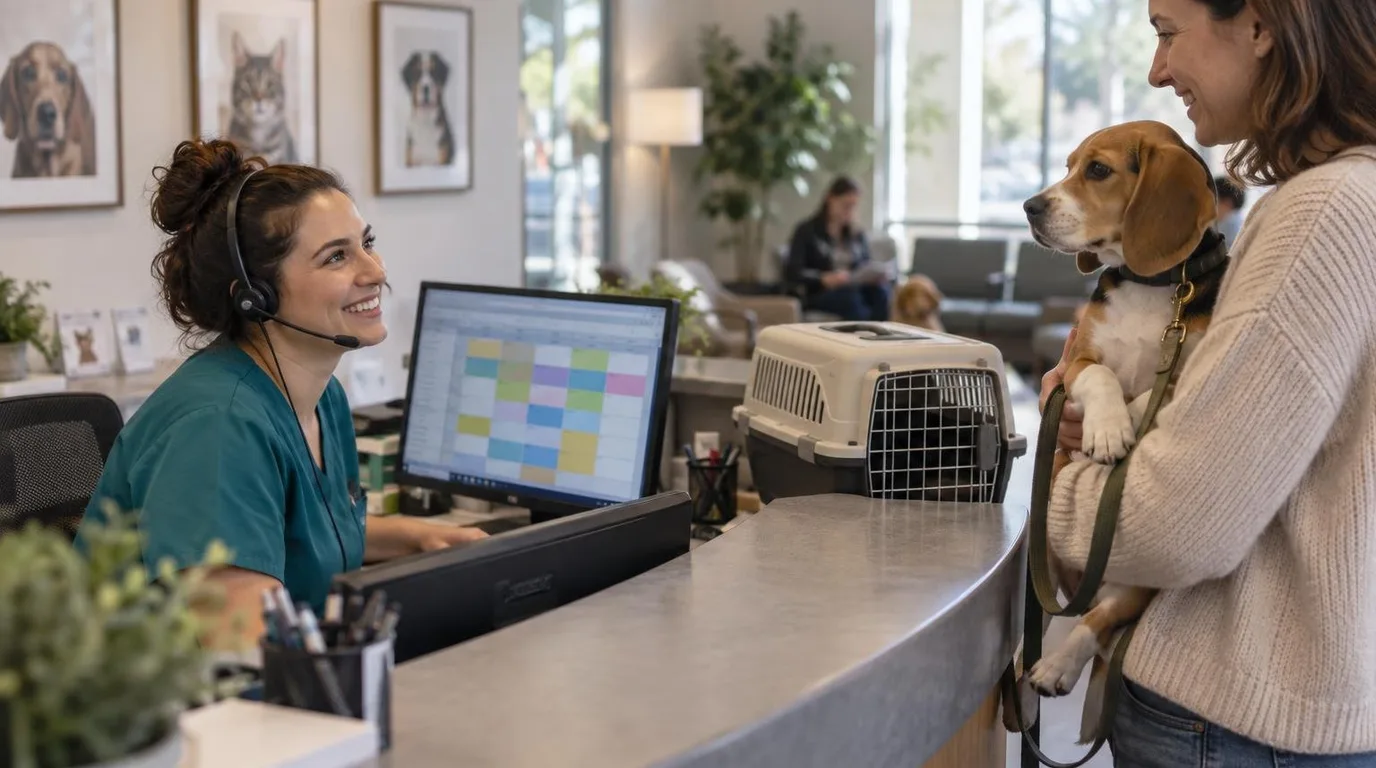
A veterinary receptionist, often called a client service representative or CSR, runs the front desk of an animal hospital. You answer the phones, book and confirm appointments, check patients in and out, present estimates and take payments, handle records requests, and route urgent calls to the medical team using the practice's triage protocol. You usually don't need a degree or a certificate to get hired, and practices train new receptionists on the job.
This guide is for people who want the job: career changers coming from retail, restaurants, or medical offices, students thinking about veterinary medicine, and kennel or assistant staff who want to move to the front.
What a veterinary receptionist does
The title says "receptionist," but the work is closer to air traffic control. On a busy day you're juggling ringing lines, clients at the counter, a doctor running 20 minutes behind, and a drop-off patient whose owner needs a call back. Here's what fills the shift.
Phones and scheduling
Phones are most of the job in many practices. Calls include appointment requests, refill requests, questions about lab results, price shopping, and worried owners describing symptoms. Scheduling is more involved than it looks. A wellness exam, a sick visit, a surgery drop-off, and a recheck all take different amounts of doctor and technician time, and a good receptionist books them so the day doesn't collapse at 3 p.m. You'll also send reminders for vaccines and annual exams and call clients to confirm the next day's appointments.
Check-in and checkout
At check-in you confirm the client's contact details, the pet's name and history, the reason for the visit, and any forms the practice requires, such as surgery consent. At checkout you walk the client through the invoice, schedule the recheck, hand over medications the doctor dispensed, and make sure discharge instructions go home with them.
Estimates and payments
You'll present treatment estimates the doctor or technician has built, take deposits for surgery or hospitalization, run payments, and explain financing options the practice accepts. Money conversations are one of the hardest parts of the job. A client who just heard their dog needs a $3,000 surgery is scared, and the person at the desk is often the one who has to say the number out loud. You can't change the price, but you can explain what the estimate covers, what the range means, and what the payment options are.
Records requests
Clients ask for vaccine certificates for boarding and grooming, and other clinics ask for records when a patient transfers or sees a specialist. You'll send records, request records from previous vets, and get new-client files ready before the first visit. Who may receive records, and how fast you have to send them, depends on your state's rules and your practice's policy, so follow the written procedure and ask when you're unsure.
Urgent calls and phone triage
This is where the job carries real responsibility. Owners call with a dog that ate chocolate, a cat straining in the litter box, or a pet that collapsed. The receptionist doesn't diagnose or give medical advice. Your job is to recognize that the call is urgent, follow the practice's triage protocol, and get the client to a technician, a veterinarian, or an emergency hospital fast.
Most practices give front desk staff a written list of signs that mean "come in now" or "go to the ER." Ask for that list during your first week and learn it. Typical examples include trouble breathing, a male cat straining to urinate, repeated unproductive retching in a large dog, seizures, being hit by a car, and swallowing something toxic. For possible poisoning, many practices also give owners the number for ASPCA Animal Poison Control, which answers at (888) 426-4435 every day of the year. A consultation fee may apply.
Euthanasia and grief conversations
You will help families through the worst day they've had with their pet. That can mean scheduling a euthanasia appointment, collecting payment and aftercare choices such as burial, communal cremation, or private cremation before the appointment so the family doesn't have to handle paperwork afterward, moving them to a quiet room instead of the lobby, and calling later when ashes are ready to pick up. Some practices send a sympathy card signed by the team.
Nobody expects you to have the right words. Clients remember whether you were calm, whether you rushed them, and whether you used their pet's name. If this part of the job worries you, ask in the interview how the practice handles euthanasia appointments and whether someone trains new staff on them.
Practice management software
Almost everything at the desk runs through the practice information management system, or PIMS. Cornerstone, AVImark, and ezyVet are a few you may see in job listings. You'll use it to book appointments, check clients in, build invoices, print records, and send reminders. No one expects you to know a specific system before you're hired. If you've used any scheduling or point-of-sale software, say so.
Skills that get people hired
Practice managers hiring for the front desk usually care more about these than about animal experience:
- Phone manner. You can stay warm and clear on a call while someone is waiting at the counter.
- Calm under pressure. You don't snap when a client is angry about a bill or a wait.
- Accuracy. You enter phone numbers, weights, and medication pickups correctly. A wrong digit in a callback number can mean a missed lab result.
- Comfort with money. You can state a price, take a deposit, and handle a declined card without apologizing for the practice.
- Judgment about when to escalate. You know when a question goes to a technician or doctor, and you don't guess.
- Reliability. Front desks open early, close late, and run on Saturdays. Showing up on time for every shift matters more than almost anything else.
If you speak a second language, put it near the top of your resume. Being able to explain an estimate or discharge instructions in a client's first language is a real asset at the desk.
How much do veterinary receptionists make?
BLS doesn't publish a separate occupation for veterinary receptionists. It counts them in a broader category, receptionists and information clerks, which covers front desk staff in every industry. BLS does break that category down by industry, and veterinary services (NAICS 541940) is one of the industries it reports.
In May 2025, veterinary services employed 55,330 receptionists and information clerks, about 12% of the industry's 471,540 workers. Their median wage was $18.23 an hour, or $37,910 a year, and their mean wage was $39,360 (BLS OEWS, veterinary services).
Here's how that compares with receptionists in other settings, all from May 2025 BLS data:
| Where receptionists work | Median hourly | Median annual |
|---|---|---|
| Veterinary services | $18.23 | $37,910 |
| All industries | $18.27 | $38,010 |
| Offices of physicians | $19.01 | $39,550 |
| Offices of dentists | $22.36 | $46,500 |
Sources: veterinary services, all industries, offices of physicians, offices of dentists.
Two things stand out. First, veterinary front desk pay is close to the receptionist median for all industries, but dental offices pay noticeably more for similar work. If you're choosing between a vet clinic and a dental office purely on pay, that gap is real. Second, the range in veterinary services is narrow. The lowest 10% earned less than $14.59 an hour and the top 10% earned more than $22.59, a spread of about $8 an hour. Across all industries, the same range runs from $13.83 to $24.01, about $10 (BLS OEWS May 2025 industry-specific data; BLS OEWS profile). Moving up in pay usually means moving up in role, which we cover in the career path section below.
Read these numbers with the caveats in mind:
- The category includes some workers who aren't front desk CSRs, such as information clerks, so it doesn't line up exactly with the job title.
- BLS reports national figures. Local pay depends heavily on cost of living.
- Emergency and specialty hospitals often pay shift differentials for nights, weekends, and holidays, and the national median doesn't show that.
When you compare offers, look at the full package: scheduled hours, overtime rules, health insurance and your share of the premium, paid time off, retirement match, and the pet care discount. A pet care discount can be worth a lot if you have animals of your own. For more on veterinary pay across roles, see our veterinary salary guide.
BLS projects receptionist employment across all industries to decline 2% from 2025 to 2035, but it still expects about 105,100 openings a year, all of them from people moving to other jobs or leaving the workforce (BLS job outlook). That projection isn't specific to veterinary practices.
Training options
Front desk jobs rarely list a certificate as a requirement. BLS says receptionists typically need a high school diploma and learn through short-term on-the-job training. In a veterinary practice, that usually means shadowing an experienced CSR before you work the desk alone. If you want structured training, these are the main options:
- IGNITE Veterinary Receptionist Certificate of Excellence (VRCE). A self-paced online certificate program built for veterinary CSRs. IGNITE says most students finish in 13 weeks at about 20 minutes a day, five days a week, and students get a year from enrollment to finish. List prices are $750 for the general practice track and $850 for the specialty and emergency track, and IGNITE runs discounts at times. The general practice track is also offered in Spanish (IGNITE VRCE). It's a private certificate, not a state credential. IGNITE publishes a template you can use to ask your practice to pay for it.
- VHMA and PVA Client Service certificate. A self-paced online program from the Veterinary Hospital Managers Association and PVA Online Training, with 15 hours of instruction covering medical basics, client communication, scheduling, stress management, and financial conversations. It costs $150 for PVA account holders and $500 for everyone else (VHMA).
- Fear Free. Fear Free's certification program includes a one-hour module called The Vital Role of Client Service Representatives, covering how to greet fearful pets, advise clients on transporting pets, and set up front desk protocols. It's open to people already enrolled in the Fear Free certification program.
- NAAVR. The North American Association of Veterinary Receptionists is a membership group for CSRs, with an online community and education resources.
- Your practice's own training. Ask in the interview what onboarding looks like: how long you'll shadow, whether there's a written phone triage protocol, and who trains you on the PIMS.
How to get hired with no veterinary experience
Many practices hire front desk staff with no clinic experience, because the core skills come from customer service work, not animal handling. To make your application stand out:
- Translate your experience. Retail, restaurant, hotel, and call center jobs all involve handling a line of impatient customers, taking payments, and solving problems on the spot. Medical and dental front desk work is even closer: scheduling, records, insurance or payment conversations, and patient privacy habits. Describe those tasks in your resume using the words from the listing.
- Show you can handle the hard parts. Give one specific example of calming an upset customer, and one of catching a mistake before it caused a problem.
- Learn the basics before you apply. Know what a wellness exam, a heartworm test, and a dental cleaning are, and why vaccines are scheduled on a calendar. You don't need clinical knowledge, but basic vocabulary helps.
- Volunteer if you can. A shelter or rescue gives you something animal-related to talk about. It isn't required.
- Apply widely. General practices, emergency hospitals, specialty centers, shelters, and mobile practices all hire CSRs. ER and specialty hospitals are often open nights and weekends, which can suit students.
If you're also weighing the clinical side, our comparison of vet techs and vet assistants explains how those roles differ, and some CSRs later cross-train as assistants.
Common interview questions and what a good answer covers
Front desk interviews are usually with the practice manager, the lead CSR, or both. Some practices then ask you to shadow or work a short shift. If they do, ask whether it's paid; our guide to the veterinary working interview explains what to expect.
"Tell me about a time you dealt with an upset customer." A good answer is a real story with a beginning, middle, and end. Say what the customer was upset about, what you said, what you did to fix it or escalate it, and how it ended. Don't make the customer the villain.
"A client calls and says their dog ate a bag of chocolate an hour ago. What do you do?" The interviewer wants to hear that you won't give medical advice and that you'll move fast. A good answer: get the pet's weight, what kind of chocolate, how much, and when, then follow the practice's protocol, which usually means getting a technician or doctor on the phone or telling the client to come in right away. Mention that you'd ask what the practice's triage list says, since you don't know it yet.
"How would you tell a client their bill is higher than they expected?" Cover three things: stay calm and don't apologize for the price, explain what the charges are for, and know when to bring in the technician or doctor who built the estimate. If the practice offers payment options, mention them.
"How do you handle a full lobby, a ringing phone, and a client at the counter all at once?" Talk about how you prioritize. A good answer: acknowledge everyone quickly, put the caller on a brief hold if the practice allows it, handle the person in front of you, and flag anything that sounds like an emergency right away.
"How would you handle a client who's coming in for euthanasia?" Interviewers listen for empathy and practical sense. Mention handling payment and paperwork before the appointment, getting the family out of the lobby, using the pet's name, and not rushing them.
"What would you do if you weren't sure whether a call was urgent?" The right answer is to ask a technician or doctor, every time. Saying "I'd rather ask than guess" is exactly what they want to hear.
"Why do you want to work in a veterinary practice?" "I love animals" is fine, but it's what everyone says. Add something about the work itself: you like fast-paced front desk jobs, you want to help people through stressful moments, or you're thinking about veterinary medicine as a long-term career.
Bring your own questions too. Ask how many CSRs work each shift, whether there's a written triage protocol, how euthanasia appointments are handled, what the schedule looks like on weekends, and how long the current front desk staff have been there. More question ideas, written for clinical roles but many of them useful at the desk, are in our vet tech interview questions guide.
Career path: from the front desk to practice manager
The front desk is a common starting point for veterinary management. A typical path looks like this:
- Lead CSR or front desk supervisor. You train new receptionists, build the front desk schedule, and handle escalated client complaints.
- Client service manager or office manager. You manage the whole front desk team, set phone and scheduling procedures, and often handle accounts receivable. The Veterinary Hospital Managers Association offers a separate Certified Veterinary Office Manager (CVOM) credential for this level, which requires one year of management experience in specific duties and two letters of recommendation (VHMA).
- Practice manager. You run the business side of the hospital: hiring, payroll, inventory, budgets, and compliance.
- CVPM. VHMA's Certified Veterinary Practice Manager credential is for experienced practice managers. To sit for the exam you need three years of practice management experience within the last seven (your title doesn't have to be "practice manager," as long as you handled 26 of the 30 management duties VHMA lists, per its CVPM FAQs), 18 college semester hours in management-related courses, 48 hours of management continuing education, and four letters of recommendation. Requirements are listed on VHMA's Earning your CVPM page. The exam fee is $695 for VHMA members and $845 for nonmembers, and VHMA offers the exam four times a year (VHMA exam dates and fees).
Not everyone wants to manage. Some CSRs move into the clinical side as veterinary assistants, and some go on to an accredited program to become credentialed vet techs. Either way, a year or two at the desk teaches you how a practice actually runs, and that experience counts in whatever you do next.
Next steps
Browse veterinary receptionist and client service jobs on VeterinaryHire and filter by location and practice type. Before your interview, read our guide to the veterinary working interview, and if you're thinking about clinical work later, see what a vet tech does.
Sources
- U.S. Bureau of Labor Statistics, OEWS May 2025: Veterinary Services (NAICS 541940), employment and wages for receptionists and information clerks (43-4171), with median and mean wages.
- U.S. Bureau of Labor Statistics, Occupational Outlook Handbook: Receptionists, May 2025 pay, training, and projections for 2025 to 2035.
- U.S. Bureau of Labor Statistics, OEWS profile for receptionists and information clerks, national percentile wages for May 2025.
- U.S. Bureau of Labor Statistics, May 2025 national industry-specific estimates (XLSX), percentile wages by industry.
- U.S. Bureau of Labor Statistics, OEWS May 2025: Offices of Physicians (NAICS 621100) and Offices of Dentists (NAICS 621200).
- Veterinary Hospital Managers Association, Earning your CVPM, CVPM exam dates and fees, Certificates and certification, and Client Service certificate.
- IGNITE Veterinary Learning, Veterinary Receptionist Certificate of Excellence (VRCE).
- Fear Free, The Vital Role of Client Service Representatives.
- North American Association of Veterinary Receptionists, naavr.org.
- ASPCA, Animal Poison Control.
The interview answers and job search tips are practical guidance, not survey findings. Training prices change often, so confirm them with the provider before you enroll. Sources checked October 16, 2026.