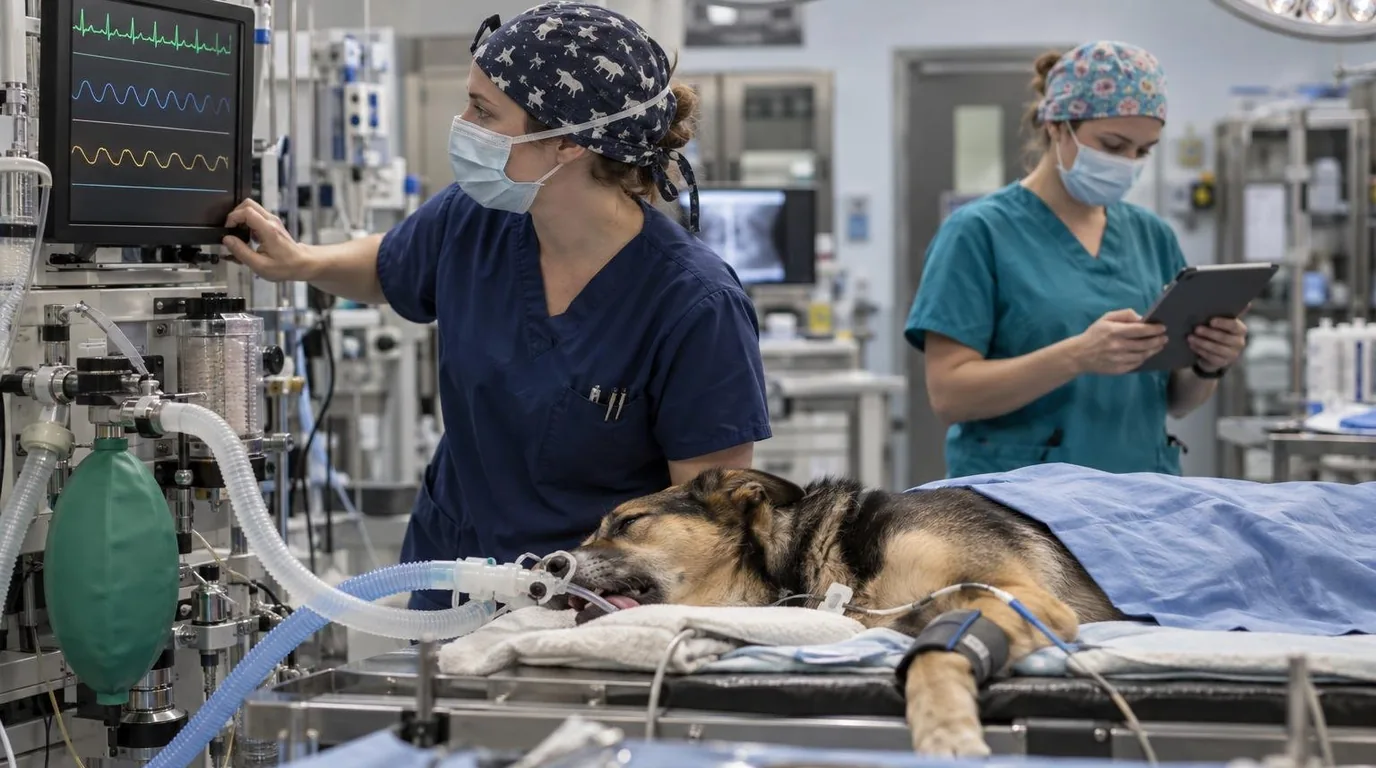
A vet tech specialty is an advanced credential, the Veterinary Technician Specialist (VTS), earned through one of 16 specialty academies recognized by NAVTA. The academies cover areas such as emergency and critical care, anesthesia, dentistry, internal medicine, surgery, and behavior. Most require three to five years of credentialed experience, a year-long case log, written case reports, and a passing score on the academy's exam.
This guide is for credentialed techs (CVT, LVT, RVT, or LVMT) who are deciding whether to specialize and which path fits the work they already do. If you're still figuring out the basic job, start with what vet techs do. If you aren't credentialed yet, read how to become a vet tech first, since every academy requires an active credential.
What the VTS credential is
The VTS is awarded by a specialty academy, not by NAVTA or a state board. NAVTA's Committee on Veterinary Technician Specialties (CVTS) sets the standards an academy must meet, and only academies the committee approves can grant the VTS letters. NAVTA notes that its CVTS is recognized by the AVMA (NAVTA).
When you pass, you add the specialty in parentheses: VTS (ECC), VTS (Anesthesia & Analgesia), VTS (Dentistry), and so on. NAVTA also allows a Veterinary Nurse Specialist (VNS) version of the logo (NAVTA).
A VTS doesn't change your legal scope of practice. Your state practice act still decides what you may do. The Academy of Veterinary Dental Technicians, for example, states that a VTS (Dentistry) does not diagnose, prescribe, or extract teeth, and it will revoke the title of anyone who does (AVDT).
All 16 recognized specialty academies
NAVTA lists 11 academies with full recognition and 5 with provisional recognition. Provisional academies still credential techs. They're earlier in NAVTA's approval process (NAVTA list of approved academies). The descriptions below come from NAVTA's list and each academy's site.
Fully recognized
- Emergency and critical care (AVECCTN). Triage, stabilization, and ICU nursing for unstable patients. The academy certifies techs to work in well-equipped, well-staffed emergency or critical care hospitals.
- Dentistry (AVDT). Dental radiographs, charting, cleanings, nerve blocks, and assisting the veterinarian in oral surgery, endodontics, and orthodontics. You don't have to work for a board-certified dentist, but you need access to advanced dental procedures.
- Internal medicine (AIMVT). Non-surgical disease work in referral services. NAVTA lists subspecialties in small animal, large animal, cardiology, neurology, and oncology.
- Anesthesia and analgesia (AVTAA). Anesthesia and pain management for higher-risk patients. AVTAA says referral hospitals with board-certified doctors are usually the best places to collect qualifying cases.
- Zoological medicine (AVZMT). Medical care of zoo species. The academy was created for techs working in zoological medicine.
- Clinical practice (AVTCP). Broad, advanced care within one species group: canine/feline, feline, exotic companion animal, or production medicine. It's modeled on the ABVP and aimed at techs in advanced primary care and multi-service referral practices.
- Clinical pathology (AVCPT). Lab testing from sampling to reported results, in clinic labs, diagnostic and reference labs, research, industry, and academia.
- Nutrition (AVNT). Dietary management of healthy and sick patients, working with veterinary nutritionists.
- Surgery (AVST). Surgical nursing, the operating room, instruments, and sterilization. Full NAVTA recognition came in July 2023 (AVST FAQ).
- Behavior (AVBT). Behavior health, problem prevention, training, and behavior modification. AVBT says its specialists work in general practice, shelters, research, and academia.
- Equine nursing (AEVNT). Advanced nursing care of horses. The credential is written VTS-EVN.
Provisionally recognized
- Laboratory animal (ALAVTN). Care of animals in research settings. NAVTA lists tracks in research clinical nursing, research surgeon, and research anesthetist.
- Ophthalmology (AVOT). Eye exams, diagnostics, and surgical support, usually in a referral ophthalmology service.
- Dermatology (ADVT). Skin, ear, and allergy work, including procedures and client education, in dermatology referral practices.
- Diagnostic imaging (AVTDI). Radiography, fluoroscopy, CT, MRI, ultrasound, and nuclear medicine, in imaging departments at referral and teaching hospitals.
- Physical rehabilitation (APRVT). Rehab therapy for orthopedic, neurologic, and post-surgical patients, in rehab and sports medicine services.
Several blog lists online still show surgery and other academies as provisional. Check NAVTA's live list before you plan around an academy's status.
The requirements pattern
Every academy writes its own rules, but nearly all of them ask for the same kinds of evidence:
- An active tech credential for every year of experience you claim.
- Hours in the specialty, earned after you were credentialed and inside a recent window, usually five years.
- Continuing education in the specialty, often with rules about who taught it.
- A skills list signed by a VTS or board-certified veterinarian who watched you perform each skill.
- A case log of 50 or more cases collected during one application year.
- Four or five case reports written from the log.
- Two letters of recommendation, usually from a VTS or specialist in the field.
- An exam, given once a year after your application is accepted.
Here's how the six academies most techs ask about compare. Figures come from each academy's current application pages.
| Academy | Experience required | Specialty CE | Case log | Case reports | Exam |
|---|---|---|---|---|---|
| Emergency and critical care (AVECCTN) | 8,000 hours in ECC within 5 years, starting with the cycle that opens November 1, 2026 (was 6,000) | 50 hours (was 25) | 50 or more, up to 75 | 4 | 200 multiple-choice questions, online, once a year in September |
| Anesthesia and analgesia (AVTAA) | 8,000 hours and 4 years credentialed, with at least 6,000 hours of anesthesia care | 40 hours | 50 to 60, at least 75% ASA III or higher | 4 | 200 multiple-choice questions plus a short-answer clinical exam |
| Internal medicine (AIMVT) | 3 years and 6,000 hours in internal medicine, with 4,500 direct contact hours in your subspecialty | 40 hours, at least 28 in your subspecialty | 50 or more | 4 | Plus 3 exam questions you write |
| Dentistry (AVDT) | 3 years and 6,000 hours credentialed, 2,000 of them in dentistry in the last 2 years, then a 2-year mentorship | Required wet labs and advanced lectures | 50 or more | 5 | Remote written exam of 150 to 200 questions, then a practical exam |
| Surgery (AVST) | 10,000 hours credentialed, with 6,000 in a surgical environment and 4,500 on surgical duties | 40 hours | 50 to 75 | 4 | In person, once a year in October. Before applying, master 72 of the 79 skills on the skills list |
| Clinical practice (AVTCP) | 10,000 hours credentialed, earned over 5 to 7 years | 50 hours | 50 to 60 | 4 | Virtual exam at an approved testing site |
Sources: AVECCTN application information and exam information; AVTAA requirements and FAQ; AIMVT core requirements; AVDT application process, credentialing, and exam; AVST 2027 instructions, future candidates page, and fees; AVTCP FAQ.
A few details from those pages are worth knowing before you start:
- The case year is fixed. AVTAA and AVTCP collect cases from January 1 to December 31. AVECCTN runs November 1 to October 31. AIMVT runs October 1 to September 30. Cases from before your application year don't count.
- Who signs your skills matters. AVTAA accepts sign-off only from a board-certified or board-eligible doctor or a VTS who works directly with you (AVTAA). If no one like that works at your hospital, you can't complete the skills list there.
- CE speakers are checked. AVTAA rejects CE taught by presenters who hold only a DVM or a tech credential, among others. It wants VTS members, diplomates, or board-eligible doctors (AVTAA 2025 application packet).
- Hours can't double-count. AVST says that if you recently earned a VTS in another discipline, you must log 6,000 surgical hours before you start its application (AVST).
How long it really takes
Add the experience requirement to the application cycle. The cycle alone is close to two years for most academies, because you log cases for a full year and the exam comes after review.
- AVECCTN: Part A (hours, CE, and letters) opens November 1 and is due March 31. Part B (skills, case log, and case reports) is due October 31. For the 2027 exam, Part A was due March 31, 2026, and Part B is due October 31, 2026 (AVECCTN). The exam is held once a year in September (AVECCTN exam information).
- AVTAA: The pre-application for the 2027 exam was due May 31, 2026, and the full application is due in December 2026 (AVTAA pre-application).
- AIMVT: Part 1 is due March 15 and Part 2 on September 30, with the exam the following year (AIMVT).
- AVDT: After acceptance, the credentialing process takes two years before you can sit for the written exam (AVDT).
So a tech who starts in emergency work right after passing the VTNE would need about four years of full-time ECC hours under the new AVECCTN rule, then roughly two more years of application and exam. Six years from credential to VTS (ECC) is a realistic plan.
Acceptance rates
Applications get rejected, often for format or case selection rather than skill. Two academies publish numbers:
- AVECCTN: From 2021 to 2026, 223 of 880 applicants (25%) passed the full application process. The drop came in Part B: 736 passed Part A, 469 submitted Part B, and 223 passed it (AVECCTN). The academy cites those numbers as its reason for raising the hour and CE minimums.
- AIMVT: The overall application acceptance rate was 41.2% across 2016 to 2024, and 56.3% in 2024 (AIMVT).
Some academies offer help. AVECCTN posts example case reports, AVTAA offers voluntary mentors to applicants who pass its pre-application, and AVDT requires every applicant to work with a VTS (Dentistry) mentor. Use them before your case year starts, not during it.
What it costs
The academy fees are modest. The bigger costs are CE travel, books, and the unpaid hours spent writing case reports. Published fees from the academies that list them:
| Academy | Application fees | Exam fee | Annual dues after you pass |
|---|---|---|---|
| AVECCTN | Not listed on the current page | $325 (2026 exam) | Not listed |
| AVTAA | $100 pre-application | Paid after acceptance, amount not listed | Not listed |
| AIMVT | $25 Part 1, $50 Part 2 (2024 cycle) | Not listed | $50 (2026) |
| AVST | $25 pre-application, $50 final | $150 | $50 |
| AVTCP | $50 pre-application, $50 final | $275 | $53 |
Sources: AVECCTN exam information, AVTAA pre-application, AIMVT 2024 application information and application FAQs, AVST fees, AVTCP FAQ.
AVDT also requires NAVTA membership and a subscription to the Foundation for Veterinary Dentistry before you apply (AVDT). AVTAA doesn't refund its $100 pre-application fee if the application is rejected, so check refund rules before you pay. Before you start, ask your practice whether it will pay the fees, give paid time for CE, and cover recertification.
Does a VTS raise your pay?
There's no reliable national figure for it. BLS doesn't track VTS holders separately. Its median for all veterinary technologists and technicians was $47,380 in May 2025 (BLS). NAVTA's 2024 Demographic Survey reported an average annual gross income of $53,759 and an average hourly rate of $32.89 among 1,404 respondents, but the published report doesn't break pay out by VTS status (NAVTA).
Articles that rank the "highest paid vet tech specialties" usually rely on self-reported salary sites with small samples. We couldn't verify any of those figures against a primary source, so we haven't repeated them here.
What you can check is the job in front of you. When you interview, ask directly whether the hospital has a pay step or title for a VTS, whether it pays for the application and exam, and whether VTS techs get protected time for teaching or protocols. Our veterinary salary guide has the state and setting data.
How to pick a specialty
The academy you choose has to match the hospital you work in, because you can only log cases you actually handle.
- You work overnights in an ER or ICU. AVECCTN is the obvious fit. AVTAA is possible if most of your hours are anesthesia care and a board-certified doctor or VTS works with you during your case year.
- You run most anesthesia in a referral surgery service. Look at AVTAA or AVST. If you've just earned another VTS, AVST requires 6,000 new surgical hours before you apply.
- You work in a busy general practice and do a bit of everything. AVTCP was built for advanced primary care. AVDT is also realistic if your practice does a high volume of dental radiographs and advanced procedures.
- You work in research. ALAVTN covers research nursing, surgery, and anesthesia.
- You want to move to a referral service. Read the academy's skills list first, then use it in interviews. Ask whether the hospital has a VTS or diplomate who could sign off on your skills.
Ways to specialize without a VTS
A VTS takes years. These shorter credentials are useful on their own or as steps along the way:
- Fear Free certification. Online modules on reducing fear, anxiety, and stress in patients. You pass each module with a score of 80% or higher. A single membership costs $299, then $149 a year to renew (Fear Free).
- Canine rehabilitation certificates. The Canine Rehabilitation Institute's CCRVT/CCRVN certification for credentialed techs combines two coursework modules with a 40-hour internship (Canine Rehabilitation Institute). The University of Tennessee runs a separate canine rehabilitation certificate program. Rehab experience also counts toward the APRVT path.
- CVPM, if you're moving into management. The Veterinary Hospital Managers Association requires three years of practice management experience in the past seven, 18 college semester hours in management courses, 48 hours of management CE in the past three years, and four letters of recommendation (VHMA). This is for practice managers, not clinical techs.
Next steps
If you're building hours toward a VTS, the hospital matters more than anything else. Browse vet tech jobs on VeterinaryHire and filter for emergency, specialty, and referral practices. To apply, see our guide to the vet tech resume and cover letter and our list of vet tech interview questions. Use the veterinary salary guide to check an offer.
Sources
- NAVTA, Veterinary technician specialties and List of approved academies.
- NAVTA, 2024 Demographic Survey results (1,404 member responses).
- U.S. Bureau of Labor Statistics, Occupational Outlook Handbook: Veterinary Technologists and Technicians, pay data for May 2025.
- Academy of Veterinary Emergency and Critical Care Technicians and Nurses, Application information and Examination information.
- Academy of Veterinary Technicians in Anesthesia and Analgesia, Credential requirement FAQ, Membership FAQ, 2027 pre-application requirements, and 2025 application packet.
- Academy of Internal Medicine Veterinary Technicians, Apply, Core requirements, and Application FAQs.
- Academy of Veterinary Dental Technicians, Application process, Credentialing guidelines, Exam, and Extraction position statement.
- Academy of Veterinary Surgical Technicians, 2027 application overview, Future candidates, FAQ, and Fees.
- Academy of Veterinary Technicians in Clinical Practice, Frequently asked questions.
- Fear Free, Membership pricing.
- Canine Rehabilitation Institute, CCRVT/CCRVN certification.
- Veterinary Hospital Managers Association, CVPM application requirements.
Academy requirements and fees change every application cycle, so download the current packet from the academy before you start logging cases. Scope of practice is set by your state, not by a VTS. Sources checked October 16, 2026.